
From installer to platform: the road to the sector's operating system
We were born installing. That's why the platform works: every feature came out of a problem we had already suffered on site.

Juan Manuel Sobral
CTO · instantTech
The work came first
The first version of our operation was a shared spreadsheet, a messaging group and a lot of phone calls. It worked with dozens of installations a month and broke with hundreds. That breaking point was the best requirements document we have ever had.
We knew what hurt: not knowing the status of an order, repeating the same information to three people and finding out too late that an installation needed material that wasn’t in the van.
The calculator was the first piece
We started with the quote because it was the source of almost all the friction. Instead of estimating by location, we modelled what actually drives the cost: the equipment chosen and the distance between the electrical panel and the parking space, in metre bands.
That let us close a price at the point of sale and leave the exception — a wrongly declared distance — to an adjustment on site. The unplanned consequence was commercial: with a fixed price, installation started selling itself inside the product page.
From internal dashboard to the platform
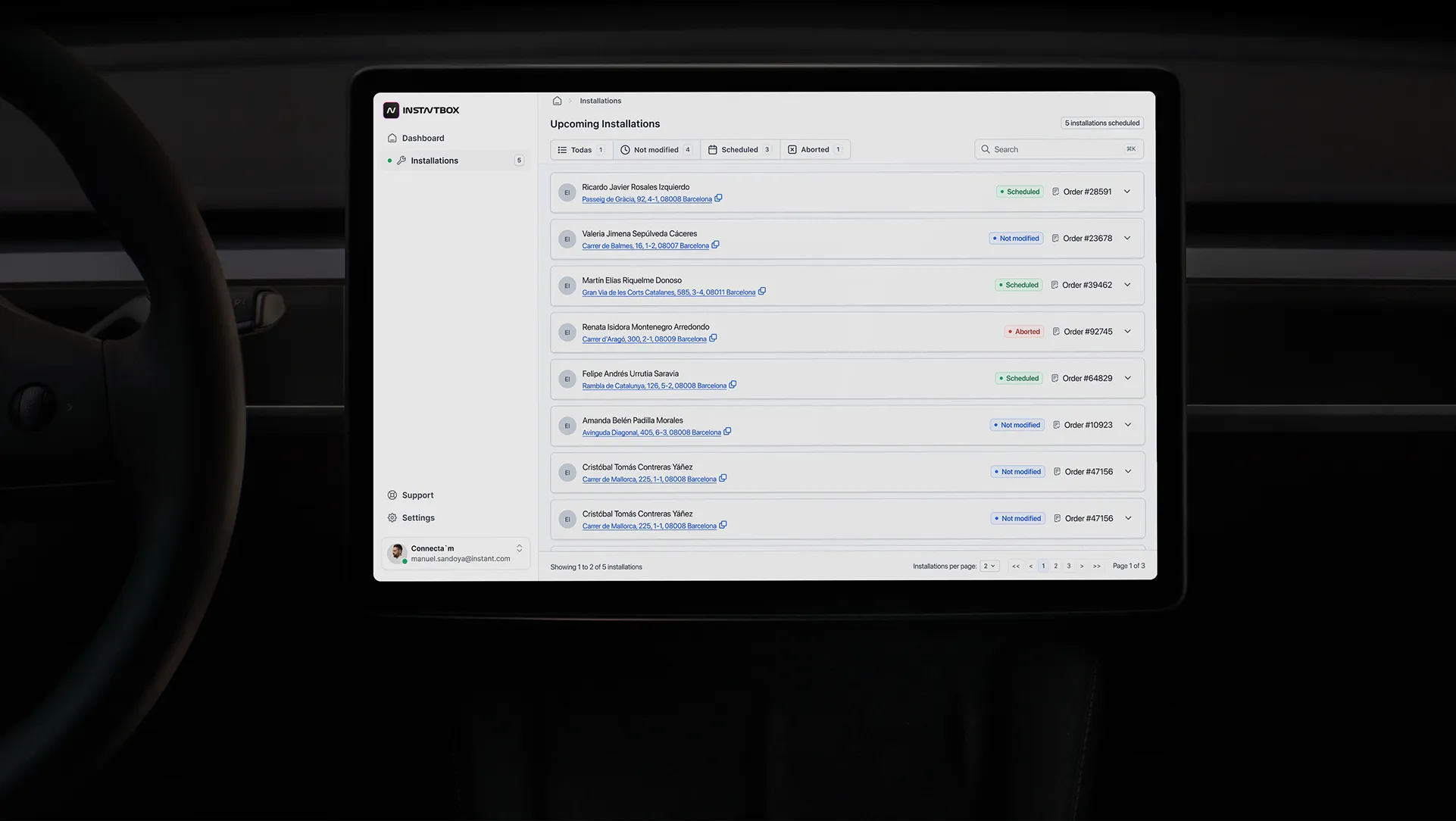
The second block was the dashboard. At first it was an internal tool to assign work by zone and watch SLAs. When brands started asking us for the status of their orders, it became clear the dashboard had to be theirs.
That’s how the platform was born: orders, installers, lead times and metrics in real time, with the brand seeing exactly what we see. Transparency turned out cheaper than reporting.
API and app: the two ends
At the top, the API lets installation appear inside the brand’s checkout or configurator, without the customer jumping to another site. At the bottom, the installer app brings together schedule, materials, documentation and work reports.
They’re the two ends of the same flow. If either one fails, the 72-hour promise stops being sustainable, however good the platform is in the middle.
What being the sector’s operating system means
We don’t aim to be the go-to installer in every country. We aim for installation to be a function any operator can call: a network where there is one, the platform everywhere.
We keep running our own field work for a practical reason: it’s the only quality control that can’t be simulated. Every new feature is tested against our own operation first.
«We didn’t build software for installers. We built the software we were missing when we were the installers.»
Federico Rodríguez Canabarro, CEO
20K+
completed installations
Charge points delivered and legalised to date.